
Virtual Fundraising Ideas: 7 Creative Campaigns to Inspire Your Next Nonprofit Event


Virtual fundraising has become one of the most reliable ways nonprofits reach supporters. A well-run online campaign costs less to produce than a traditional gala or 5K, removes geography as a barrier to participation, and lets donors give on their own schedule.
The nonprofits seeing meaningful results are the ones treating their online events with the same strategic rigor as their biggest in-person fundraisers: clear goals, a specific audience, and a donation experience that doesn’t get in the way of generosity.
Below are seven virtual fundraising ideas, complete with what makes each one work and where it fits best — plus a few tips for pulling any of them off successfully.
What Is Virtual Fundraising?
Virtual fundraising, or online fundraising, is any campaign or event run online, from a social media or email campaign to a live streamed event. Unlike a traditional in-person fundraiser, there’s no venue, no catering, and no bulky materials to manage — the entire experience lives in a donor’s inbox, social feed, or browser.
Lower overhead means more of every dollar raised goes to your mission. A digital format means a donor in another state or country can participate as easily as one down the street. And because every click, open, and gift is tracked, you can see exactly which story or ask drove a donation.
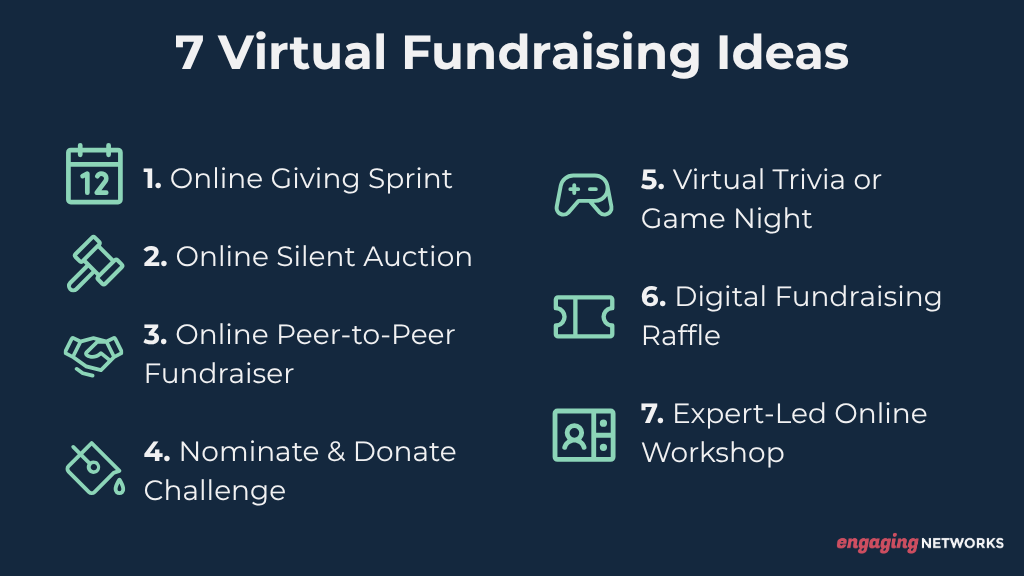
7 Creative Virtual Fundraising Ideas
Not every virtual fundraiser is chasing the same goal. Some of the ideas below are built to bring in new donors, others to deepen the relationship with the ones you already have. They work because they tap into tried and true tactics — from creating a sense of friendly competition to leaning on the trust supporters already have in their own networks.
Here are seven virtual fundraising ideas, each with the specifics on why it works, what it’s best for, and how to run it well.
1. Online Giving Sprint
For their first-ever Day of Giving, Children’s Wisconsin built a tailored email series around four real patient stories. Going in with a $40,000 match secured, the campaign raised $55,000 — $15,000 past the goal — with a real-time fundraising thermometer, countdown timers, and abandoned-cart recovery all playing a role.
Why it works: Running a focused campaign with a specific deadline and fundraising goal creates a sense of urgency that a generic appeal can’t match. Pairing that urgency with a matching gift gives donors a concrete reason to give now rather than “sometime.”
Best for: Fundraising for a specific goal (like starting a new program or beating last year’s results).
Tips for success:
- Don’t rely on one generic ask; segment your outreach around specific stories or programs so different donors see the piece of your mission that’s most likely to resonate with them.
- A live donation thermometer and countdown timer both add visible momentum, and an abandoned-cart follow-up can recover gifts that would otherwise be lost.
- Test your approach and build on what worked in future online giving sprint events.
2. Online Silent Auction
A silent auction moves the classic bidding format to the virtual world. Supporters can browse donated items and place bids from their phone or computer over a set window of time. When time runs out, the highest bid wins.
Why it works: A catalog of unique, hard-to-get items turns giving into an exciting shopping experience, and different price points let a $25 bidder and a $2,500 bidder both find something worth going after. Competition is a factor, too; bids often climb past an item’s actual value in the final minutes.
Best for: Organizations with an engaged donor base and access to unique, desirable items or experiences worth bidding on.
Tips for success:
- Source items that are hard to get anywhere else, like a behind-the-scenes experience, a piece of signed local art, or a weekend getaway. Bonus points if they fit the story of your mission.
- Set a starting bid low enough to invite the first bid (often 40 to 50% of an item’s value), with a modest bid increment so the price climbs steadily without big jumps that discourage competition.
- Build in a hard countdown for every item, and make sure outbid notifications go out in real time. A donor who doesn’t know they’ve lost the lead is a donor who doesn’t come back to rebid.
3. Online Peer-to-Peer (P2P) Fundraiser
The National Trust for Historic Preservation provides grants and other support for the iconic Route 66. When they partnered with Dylan Huynh, a travel influencer touring Route 66, the P2P fundraiser tied directly into the videos he was already making, giving his audience a built-in reason to care and give. Dylan raised $7,000 and counting for the National Trust.
Why it works: P2P campaigns extend your reach into networks you wouldn’t reach otherwise. When a supporter shares their own fundraising page, their friends and family are hearing an appeal from someone they trust, not a faceless organization. Visible progress and comments on a supporter’s page also add a layer of social proof that can nudge hesitant givers toward donating.
Best for: Organizations with supporters, volunteers, or partners willing to fundraise on their behalf — especially when there’s a natural tie between the fundraiser and the person doing the asking.
Tips for success:
- Don’t wait for the right supporter to come to you. Identify a handful of engaged donors, volunteers, or online creators aligned with your mission and invite them to fundraise on your behalf.
- Give P2P fundraisers a template to start from rather than a blank page. A pre-built page with your branding, suggested copy, and a clear goal removes the biggest barrier to participation.
- Recognize top fundraisers publicly and make it easy for their networks to see progress and leave encouragement, since that visibility is part of what drives momentum.
- Find more ideas and tips in our webinar recap, Building Million-Dollar Movements: What We Learned About P2P Fundraising That Actually Works.
4. Nominate and Donate Challenge
Remember when the ALS Ice Bucket Challenge took the internet by storm in 2014? Participants filmed themselves getting doused with ice water (a nod to the numbness ALS patients feel), donated to the cause, and tagged others to follow suit. You can borrow this format for any online fundraiser — just swap the ice bucket for an action tied to your mission.
Why it works: Being personally invited to donate by someone you know is much harder to ignore than a general appeal, and watching a challenge spread across your feed adds a sense of social momentum that makes it fun to join the movement.
Best for: Organizations looking to build awareness and reach new audiences, especially younger ones.
Tips for success:
- The action needs to be exciting or surprising enough to grab attention on its own. It also helps if the action has some real connection to your mission.
- Give your challenge a dedicated hashtag and a visible way to track who’s taken part.
- Get early traction with a handful of volunteers, board members, or ambassadors. They don’t need to have huge followings — just a few friends or family members who will accept the challenge.
5. Virtual Trivia or Game Night
A virtual trivia or game night moves a familiar social event online. Supporters register in teams, join a live stream, and compete for prizes or bragging rights. Donations can be collected through the ticket price, a mid-game ask, or both.
Why it works: A game format gives supporters a reason to show up beyond writing a check. It’s a shared experience they’ll actually enjoy, which tends to translate into stronger word-of-mouth and repeat participation.
Best for: Community-focused organizations looking for an easy, low-cost way to bring supporters together.
Tips for success:
- Keep team sizes small enough that everyone stays engaged. For trivia, four to six people is usually the sweet spot.
- Add a donation moment beyond the ticket price, like a bonus question donors can pay to unlock or a simple mid-event ask.
- Bring in a sponsor for a dedicated round — for example, a “blitz round” where a local business pledges a set dollar amount for every correct answer, turning one round into its own mini fundraiser.
6. Digital Fundraising Raffle
Everyone loves a shot at winning something big. A digital raffle gives donors entries toward a single standout prize, with the winner drawn at random once the window closes.
Why it works: The prize does most of the persuading. A donor doesn’t need to know your organization’s story or trust your mission deeply to buy a ticket; they just need to want what’s up for grabs. That makes a raffle one of the easiest asks to put in front of someone who’s never heard of your mission before.
Best for: Low-cost, low-lift campaigns aimed at new donors.
Tips for success:
- Lead with one flashy, high-desirability prize, like a pair of concert tickets, a trip, or a unique experience.
- Use tiered entries to encourage bigger gifts, like $10 for a single entry or $25 for five. Encourage social media sharing by awarding additional entries.
- Check your state’s raffle and sweepstakes rules before you launch. Most jurisdictions require a free, no-purchase-necessary way to enter, so build that option in from the start.
7. Expert-Led Online Workshop
An expert-led session gives access to a live streamed class or workshop led by staff, a board member, or someone connected to your mission — either for a ticket price or suggested donation.
Why it works: Beyond supporting your mission, donors walk away with something tangible from the gift itself. It also gives you a way to highlight staff, board members, or beneficiaries with expertise worth sharing.
Best for: A low-cost way to fundraise and deepen supporter relationships at the same time.
Tips for success:
- Pick a topic your organization is uniquely positioned to teach, drawing on the expertise already on your team. A chef on staff could lead a cooking demo, a board member who’s passionate about fitness could run a workout class, or a program participant could share a skill alongside their story.
- Keep it to one clear price point (or a simple “pay what you can”) so the transaction doesn’t add friction.
- Set a fundraising goal for the session and promise something specific if it’s hit live, like some bonus content or a fun dare for the host.
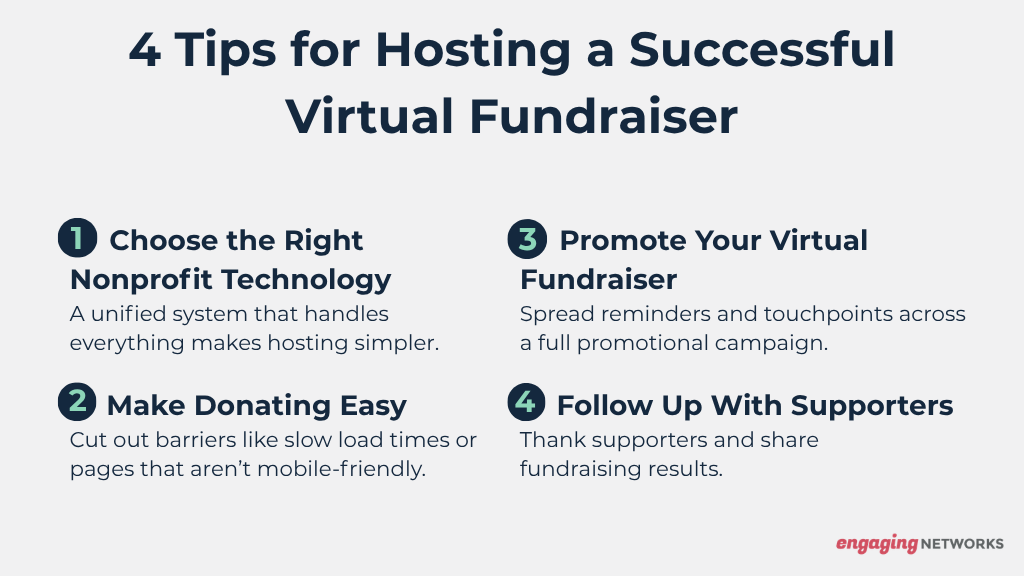
Tips for Hosting a Successful Virtual Fundraiser
Choose the Right Nonprofit Technology
The platform behind your campaign matters as much as the idea itself. A unified system that handles your fundraising pages, event registration, and donor data in one place means less time spent stitching tools together and more time spent on strategy.
Make Donating Easy
Every extra step between “I want to give” and “donation confirmed” is a chance to lose the donor. Keep the form fast to load, easy to complete on a phone, and free of unnecessary steps like a forced account creation.
Promote Your Virtual Fundraiser
A single announcement rarely cuts through the noise. Your campaign is competing for attention against everything else in a supporter’s inbox and feed, so plan for multiple touchpoints.
For a one-time event like trivia night, that might mean a save-the-date, reminders for team registration deadlines, and a final push the day before. For a longer fundraising window, spread reminders and fundraising updates across the full campaign.
Follow Up With Supporters
The campaign isn’t over when the countdown hits zero. There’s no handshake or face-to-face thank-you when a fundraiser happens entirely online, so the relationship depends on how you follow up. A thank-you within a day or two, paired with a genuine picture of what the campaign accomplished, can bring new donors deeper into your mission.
Best Nonprofit Software for Virtual Fundraising Events
Whichever virtual fundraising idea you run with, it works better on a platform that’s actually built to support it. Engaging Networks brings fundraising pages, event registration, P2P, marketing automation, and reporting into one system, so your team isn’t stitching together different tools to launch one campaign. Here’s what to look for, and how Engaging Networks handles each piece.
Event Registration and Ticketing
Whether you’re running a live streamed trivia night or a ticketed expert-led workshop, you need a registration process that’s fast, simple, and doesn’t drop people before they complete checkout. Engaging Networks’ event tools handle registration, ticketing, and payment in the same flow as the rest of your campaign.
Online Donation Forms
Your donation form is the single most important page in any virtual campaign. It should be mobile-optimized, quick to load, and flexible enough to support one-time gifts, recurring giving, and campaign-specific asks without custom development for every event. Engaging Networks offers pre-built templates for teams that need to launch fast, along with the flexibility to fully customize a page for more advanced workflows when a campaign calls for it.
Read more: Introducing Smart Pages: Beautiful, High-Converting Donation Pages, Built in Minutes
Marketing Automation
Manually sending every email in a multi-touch campaign isn’t realistic at scale. Automated journeys, triggered by an action like an abandoned donation or a completed registration, let your team deliver timely, relevant follow-up without adding to anyone’s workload. Engaging Networks’ automated marketing tools handle these journeys natively, using the same donor data already sitting in the platform.
CRM and Payment Integrations
A virtual fundraiser generates a lot of donor and transaction data fast. Integrations that sync that data with your CRM and payment processor in real time mean your team isn’t reconciling spreadsheets after the fact, and can act on donor behavior while the campaign is still live. Engaging Networks connects directly with major CRMs and payment processors, so that data flows seamlessly.
Reporting and Analytics
You can’t improve what you can’t measure. Unified reporting that pulls fundraising, email, and event data into one view makes it possible to see what actually drove results, so you can walk into your next campaign with real evidence instead of guesswork.
A Platform Built for All Your Fundraising Needs
A great virtual fundraising idea still needs the right platform behind it to deliver results. Engaging Networks brings donation pages, event tools, P2P, marketing automation, and reporting all into the same system, so launching a new campaign doesn’t mean bolting on another tool or exporting data by hand.
Our platform also connects to the advocacy, email, and in-person fundraising your team is already doing. Request a demo to see how you can build your next digital fundraiser in Engaging Networks.